The Weight of a Handmade Object: Woodturning & Emotional Connection
There’s a moment that stays with me from a market in the Assembly Rooms on George Street in Edinburgh.
It was in 2025 and I’d taken along a piece that was slightly different from my usual work. A heavy beech form with an exaggerated wide rim. Somewhere between a wooden bowl and a sculptural object. This piece was carried a surprising amount of weight in the hands. The majority of the wood was still in place, only a small section hollowed out.
I’d stained the outside red, while the interior was left natural.lathe.
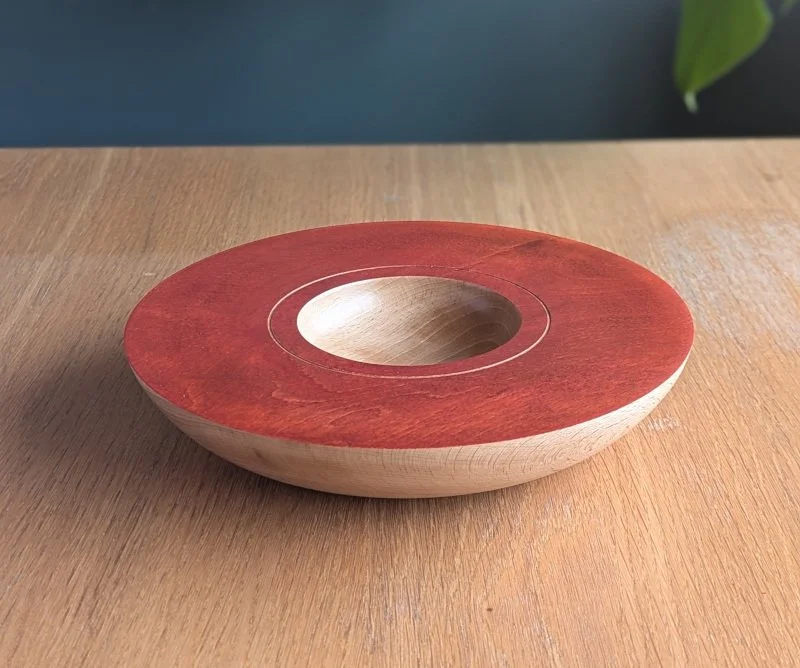
Visually, it was probably one of the more overtly artistic pieces I’d made. What surprised me wasn’t the reaction to how it looked, but to how it felt.
A woman picked it up and closed her eyes. Then simply stood holding it for a while. She ran her hands across the surface, feeling the weight and the finish. Almost absent-mindedly.
Then she told me it felt calming. Meditative even. She said she could imagine sitting at home holding it - because the physical weight gave her a sense of comfort. It was the right piece for the right person at the right time. She bought it.
Up until then, I’d mostly thought about the piece in visual terms. The proportion and contrast of the colours. I hadn’t really considered weight as an emotional quality in woodturning.
As a maker, you perhaps become slightly immune to some of those sensory experiences. When you’ve handled the piece constantly throughout the process, eventually you stop experiencing it as an object in the way somebody else does.
That interaction changed something for me.
Handmade Wooden Objects Are Experienced Physically, Not Just Visually
Since then, I’ve become much more aware of how people physically interact with handmade wooden bowls and vessels. Particularly at craft markets.
You can usually tell quite quickly when somebody genuinely connects with a piece. They stop simply looking at it and start touching it properly.
They’ll run their hands over subtle transitions in the curve or hold it differently to feel the balance. Sometimes they don’t even realise they’re doing it.
At most markets there’s often a hesitation first. A pause, a slight tilt of the head. And then they begin to feel the surface instinctively.
At that point, the object seems to shift from being decorative to something more personal.
Once someone has held a piece properly, it already feels slightly like theirs.
That’s interesting as a woodturner because so much of the work exists in details that aren’t immediately visible in photographs. Or even from a distance:
the weight distribution
the way an edge softens into the hand
the smoothness left by the finish
the subtle balance of proportion
These are often the details that determine whether somebody forms a connection to a piece.
Emotional Value of Handmade Craft
That experience made me question how I think about value.
Like many makers, I approach pricing through formulas. Material cost, workshop time, finishing time, and overheads.
I still do to a large extent. Having a structure is useful. It gives you a way to justify pricing, even if only to yourself.
But increasingly I think handmade objects operate partly on a different level.
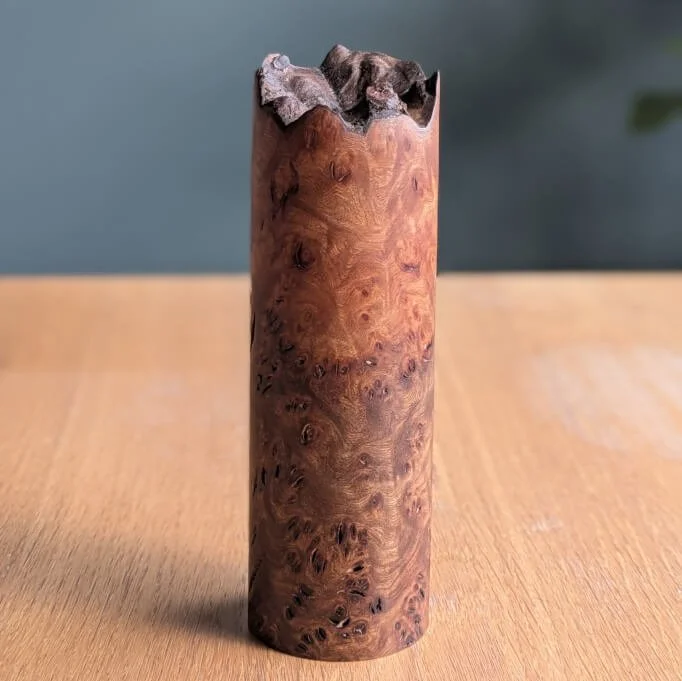
When someone is buying a wooden bud vase for example, they aren’t only paying for timber and labour.
They’re paying for:
how an object feels in their hands
how it changes a room
the emotional response it creates
the connection they form with it over time
That can be psychologically difficult to reconcile as a maker.
I carry a certain amount of discomfort around higher pricing. Partly that comes from background and circumstance. If you haven’t grown up around expensive handmade objects, it can feel strange assigning significant value to something you made yourself in a small workshop.
There’s always a voice asking:
Is this too much for a bowl?
But at the same time, I’m trying to recognise that value isn’t always strictly mathematical.
If somebody forms a genuine emotional connection to an object - if they display it prominently in their home and interact with it daily, or gift it to someone they care about, then clearly something more is happening than simple utility.
Seeing My Work in Other People’s Homes
Because I mostly sell my work through markets and online, I rarely get to see where the pieces end up.
Occasionally though, I do get to encounter them later on.
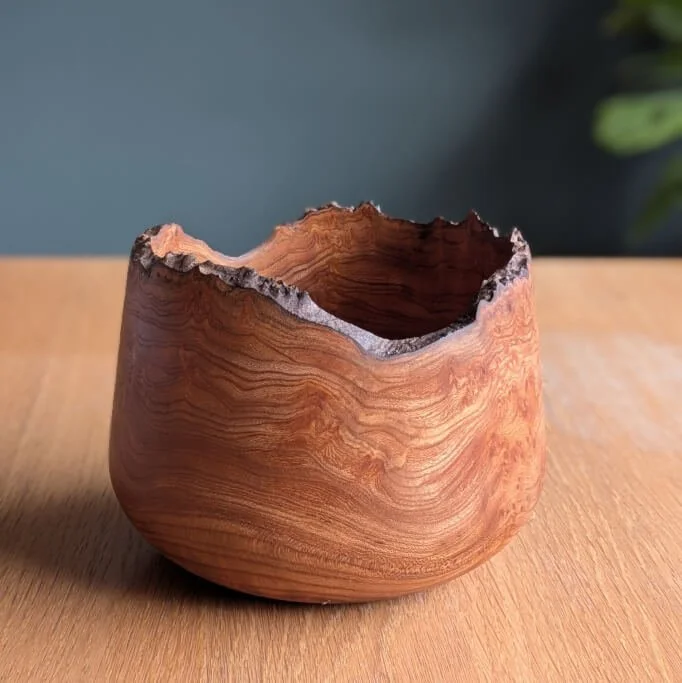
My neighbours have a bog oak bowl I made sitting in their hallway. It’s one of the first things you can see when entering the house.
They also have one of my wooden bud vases and a wooden Christmas tree displayed in their living room.
My parents’ house is similar. Some pieces were bought; others were experiments I decided not to sell and passed on instead. But they all seem to end up in pride of place somewhere.
That’s always quietly satisfying to witness.
Not because the object still feels like mine, but because it has properly entered somebody else’s environment. It’s become part of the rhythm of their home. Rather than simply an item for sale.
I also like hearing when pieces have been bought as a gift for someone special.
There’s something meaningful about the idea that somebody used an object I made to express affection toward another person. It is funny to think that an object, that started off as a lump of timber rotating on my lathe, eventually becomes a small part of a relationship.
Returning to the Original Idea
I fear I am rambling a little now. But, to go back to the beginning of the article, I’ve been wanting to revisit that original heavy beech form for a while now.
If I do, I’d probably push the idea further this time. Perhaps carving geometric lines around the rim to introduce another layer of texture. I like the idea of alternating colours between the carved sections and the surrounding surface to emphasise it. While keeping the weight central to the experience of the piece.
I don’t have a strict design plan for it yet.
Most likely I’ll wing it and see what happens.
That’s often where the most interesting work begins anyway.