A Bowl Can Be Technically Correct and Still Feel Wrong
Something I’ve been thinking about recently is when is a piece finished?
One of the hardest things to explain is how a bowl can be well made and still somehow not ‘work’.
The measurements might be right. The sanding done and the finish flawless. But visually, something just… jars.
The proportions perhaps feel awkward. The curve doesn’t quite resolve itself in a pleasing way.
Overall the bowl lacks a sense of balance. Even if most people wouldn’t immediately be able to explain why.
That feeling - knowing when a form is done - is probably the biggest part of the knowing when to stop.
Woodturning Bowl Design
Most of my wooden bowls begin with a shape in mind. Not an exact blueprint, but a rough visual target. I have a certain size and shape that I like.
Then as I’m turning the wood, I’m constantly reassessing that shape. Seeing how the piece on the lathe matches up to that vision in my head.
Removing material changes everything. A curve that looked ok five minutes ago, can suddenly feel too heavy. A rim might need softened. The foot might need reducing.
There’s a lot more stopping and looking involved than people might think.
Woodturning is often imagined as a fluid and uninterrupted process. Where the final form is simply revealed. I perhaps thought that way at the start.
But in reality, it’s much more iterative. Turn a little. Step back. Reassess. Adjust. Then repeat. Over time, you develop an instinct for spotting the balance.
That instinct is difficult to teach – well, for me anyway – because it comes from repetition. And ‘knowing’. Not that I always get it right, mind. I’m 6 years down my woodturning journey, and I still think of myself as a beginner in many regards.
But I have made enough bowls to start eventually noticing subtle differences between forms.
Two bowls can be almost identical in dimensions, yet one feels calm and resolved - while the other feels slightly ‘uncomfortable’ to look at.
I think people respond to that subconsciously. Even if they’ve never made anything themselves.
Some objects simply feel right in the hand. Others don’t.
Most people won’t analyse in detail why a bowl feels right. But they still react to it emotionally. And it’s the small decisions around proportion, weight and thickness that all contribute to that.
You notice this clearly when selling work in person.
What Sells At A Market
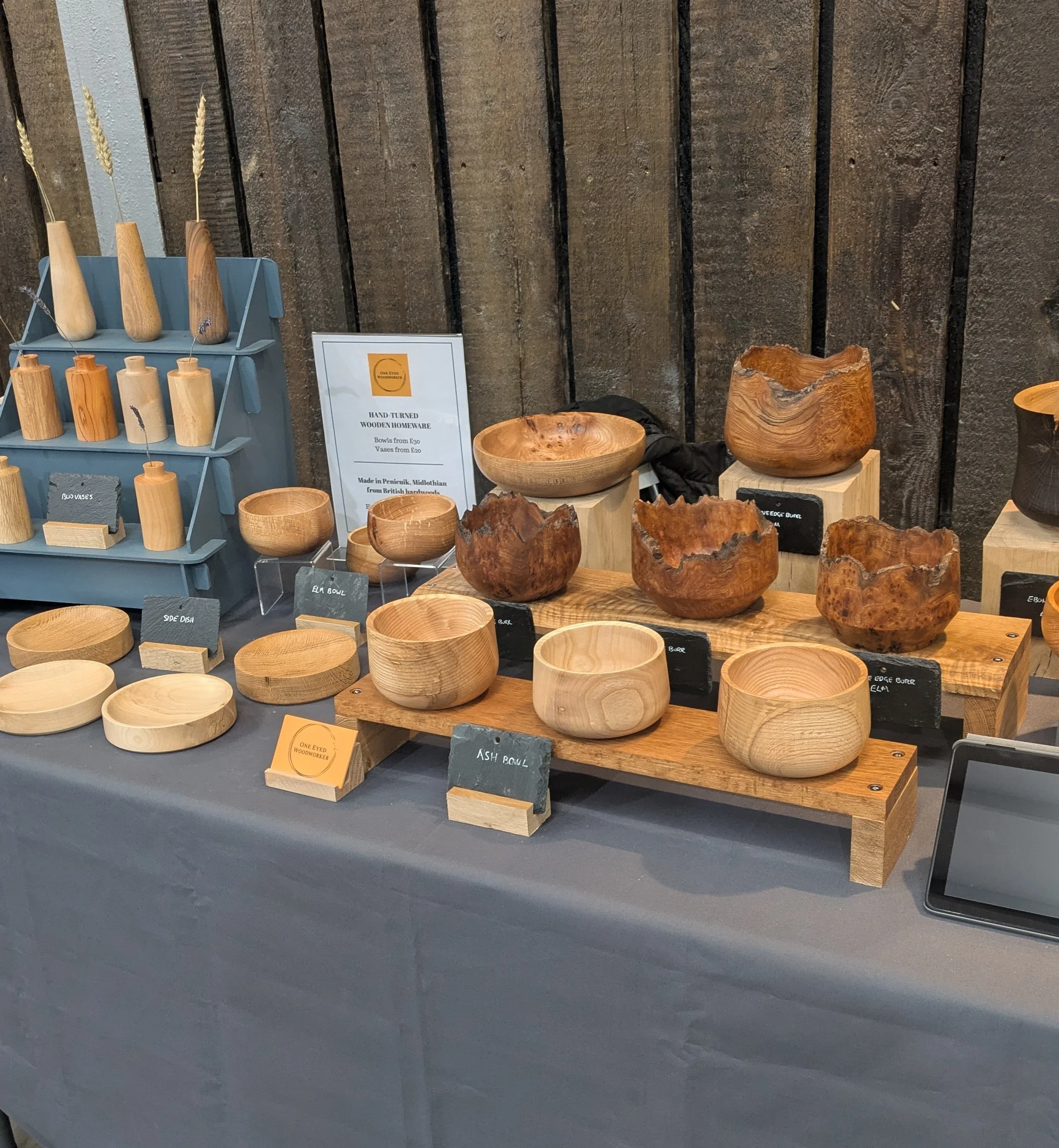
At a recent market at Bowhouse in Fife, I had two large wooden bud vases on the table that were very similar in form. Made from the same piece of oak, and finished to the same standard. Technically, there wasn’t much between them.
But people consistently preferred one over the other.
The difference was subtle. Slightly tighter proportions, a lighter visual weight, a form that just felt more resolved to the eye. Nothing most people could articulate, but something they responded to.
That kind of reaction is useful for me. It helped me to see that the proportions and visual weight of a piece truly matter. Just as much as technical execution. Even if it is annoyingly harder to quantify.
Dealing With Wood When Turning
The wood itself also forces decisions, of course. Even with kiln-dried timber, there are always surprises hidden inside a blank. A wild grain pattern that shifts. Or some small defects appear which appear as wood is removed. Which means that sometimes the material pushes the piece away from the original idea.
It can be easy to try and force the material into the original plan when it’s not going right. To try and prioritise symmetry over how the wood is truly responding to the turning. However, I’ve now come to see that the better approach (for me) is usually to adapt the shape rather than try and force it.
Some of the most interesting bowls come from a design decision on the fly.
I think when I started woodturning I was often focus on things like symmetry, or getting measurements right. And it’s not to say that those things don’t matter, but they’re not the whole story.
Over time, I’ve come to realise that a bowl can be technically perfect and still feel wrong.
And equally, a slightly imperfect bowl can feel completely resolved.
Eventually, there’s a moment in the process where the bowl starts to make sense. Nothing feels too heavy or out of place. The form settles. Even if you can’t point to a single reason why.
That’s usually when it’s finished.